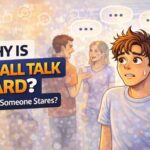

You walk into a room.
No one speaks to you directly.
No one criticizes you.
And yet… you feel judged.
You adjust your posture.
You check your clothes.
You suddenly become aware of how you’re walking, standing, even breathing.
If you’ve ever wondered why do we feel judged even when no one is saying anything, you’re experiencing a very common psychological effect that has little to do with others—and a lot to do with how your brain interprets social situations.
Let’s break it down.
Feeling Judged Without Words Is Normal
Humans are social beings.
Our brains evolved to constantly scan for:
- approval
- rejection
- acceptance
- criticism
According to research summarized by Harvard Health, the brain treats social evaluation as a potential threat—even when no words are spoken.
👉 Therefore, silence can still feel like judgment.
The Spotlight Effect: The Main Reason
One of the biggest explanations is the spotlight effect.
This is the belief that:
“Everyone is noticing me more than they actually are.”
Research from Cornell University shows that people consistently overestimate how much others pay attention to their behavior or appearance.
So when you’re in public:
- you think people notice your mistakes
- you assume people see your flaws
- you imagine silent opinions
Even if no one is actually thinking about you.
Your Brain Interprets Attention as Evaluation
When people:
- look at you
- glance at you
- stay silent around you
your brain tries to assign meaning.
It asks:
- “Do they approve?”
- “Did I do something wrong?”
- “Are they judging me?”
Since the brain dislikes uncertainty, it often assumes the worst-case scenario.
Silence Creates Mental Gaps (And the Brain Fills Them)
When nothing is said:
- there’s no feedback
- no reassurance
- no clarification
Your brain fills this silence with assumptions.
This is called negative interpretation bias, where the mind interprets neutral situations as negative.
According to the American Psychological Association, humans are wired to focus more on possible threats than safety.
Self-Awareness Increases the Feeling
If you’re naturally self-aware or reflective, you’re more likely to monitor:
- how you talk
- how you stand
- what you’re wearing
High self-awareness increases internal observation, which can turn neutral situations into imagined judgment.
| Low Self-Monitoring | High Self-Monitoring |
|---|---|
| relaxed | alert |
| spontaneous | cautious |
| natural | self-conscious |
👉 The more you watch yourself, the more judged you feel.
Social Anxiety Amplifies It
People with mild social anxiety tend to:
- overanalyze expressions
- notice small reactions
- assume criticism
According to Psychology Today, fear of negative evaluation is a key feature of social discomfort.
Even neutral faces can feel threatening.
The Brain’s Threat Detector (Amygdala)
The amygdala monitors:
- facial expressions
- tone
- gaze
- body language
If it detects ambiguity, it may activate a mild stress response.
That’s why you feel:
- tension
- nervousness
- awkwardness
Even when no one has said a word.
Why It Feels Worse in Public Spaces
Feeling judged becomes stronger when:
- you’re surrounded by strangers
- you’re in unfamiliar settings
- you’re already stressed
- you’re alone in a group
These conditions increase uncertainty—so your brain becomes more cautious.
How to Reduce the Feeling of Being Judged
✅ 1. Challenge Assumptions
Ask:
“Do I have evidence they are judging me?”
✅ 2. Shift Focus Outward
Observe your surroundings instead of yourself.
✅ 3. Accept Neutrality
Most people are focused on themselves—not you.
✅ 4. Practice Realistic Thinking
Neutral expressions often mean nothing.
According to the Cleveland Clinic, cognitive reframing helps reduce imagined judgment.
Conclusion: Feeling Judged Is a Brain Shortcut
In conclusion, we feel judged even when no one is saying anything because the brain tries to protect us socially by interpreting silence as evaluation.
It’s not always accurate—but it is automatic.
Once you understand the spotlight effect, these moments become less intense—and more manageable.